
Walk into any commercial kitchen supply showroom and you’ll face a decision that shapes your entire menu strategy: flat top or charbroiler? It’s not just about personal preference or which piece of equipment looks more impressive under the hood. The right choice depends on what you’re cooking, how fast you need to cook it, and the flavor profile your customers expect when they order off your menu.
Let’s break down what each grill actually does, where it shines, and how to figure out which one—or both—belongs in your kitchen.
What a Flat Top Grill Brings to the Table
A flat top, sometimes called a griddle, is exactly what it sounds like: a smooth, solid cooking surface heated from below. There are no grates, no gaps, and no open flame touching your food directly. Heat transfers evenly across the surface, which makes flat tops incredibly versatile.
Think about breakfast service. Eggs, pancakes, hash browns, and bacon all cook beautifully on a flat top because the surface handles delicate items without letting them fall apart or slip through grates. The same goes for smash burgers, quesadillas, stir-fried vegetables, and anything that benefits from consistent, direct contact with a hot surface.
Flat tops also excel at retaining natural juices and fats released during cooking. Instead of dripping away, those juices stay on the surface, basting the food and building flavor as they cook. This makes flat tops a favorite for diners, food trucks, and any concept built around breakfast, burgers, or made-to-order sandwiches.
Cleanup is another consideration. Flat tops require regular scraping and degreasing, but the process is straightforward compared to cleaning grates.
What a Charbroiler Delivers That a Flat Top Can’t
A charbroiler operates on a completely different principle. Whether it’s gas-powered with radiant briquettes or a true wood or charcoal-fired unit, the goal is the same: create those signature char marks and smoky flavor that customers associate with grilled perfection.
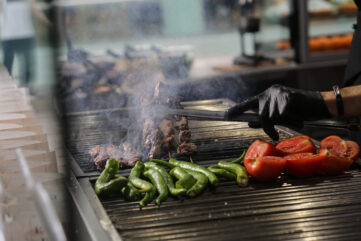
The grates on a charbroiler allow fat and juices to drip away from the food and hit the heat source below, creating flare-ups that infuse food with smoky, charred flavor. This is the equipment you want for steaks, chicken breasts, burgers with a traditional grilled taste, and vegetables that benefit from a bit of blistering.
Charbroilers also cook at higher, more intense heat than flat tops, which makes them ideal for searing. If your menu leans heavily on steakhouse-style items or you want that unmistakable grilled aesthetic on your burger patties, a charbroiler delivers results a flat top simply can’t replicate.
The tradeoff is consistency. Because heat distribution across grates isn’t as uniform as a solid surface, charbroilers require more attention from your cooks to avoid hot spots and uneven cooking.
Matching the Grill to Your Menu
The decision ultimately comes down to what you’re serving most often. If your menu is heavy on breakfast items, smash burgers, or dishes that need a controlled, even surface, a flat top is the smarter investment. If grilled flavor and char marks are central to your identity—think steaks, classic burgers, or barbecue-adjacent concepts—a charbroiler earns its place on the line.
Many kitchens don’t have to choose just one. Diners, gastropubs, and full-service restaurants often run both pieces of equipment side by side, using the flat top for versatility and the charbroiler for signature grilled items. This dual setup lets you expand your menu without compromising on quality or flavor consistency.
Before making a purchase, walk through your menu item by item. Count how many dishes would benefit from each cooking method. Consider your ticket times during peak service and whether your kitchen layout can accommodate one unit or both.
Making the Final Call
There’s no universally right answer between a flat top and a charbroiler—only the right answer for your specific menu and concept. Take stock of what you’re actually cooking on a daily basis, factor in your kitchen space and staffing, and let those realities guide your equipment investment. The best grill is the one that helps your kitchen run efficiently while giving customers the flavors they came for.