
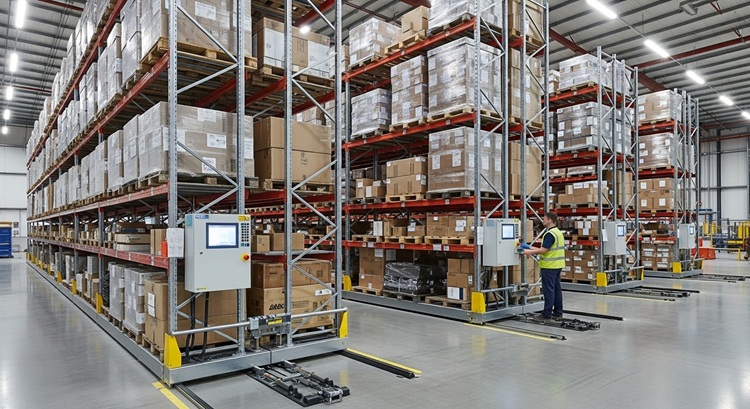
Consider, for a moment, the warehouse manager who has been told there is no budget for a larger premises but that inventory must double by the end of the quarter. It is a predicament as old as commerce itself, and for a growing number of businesses in Singapore and across the region, the answer has arrived in the form of the mobile rack – a storage system that moves, quite literally, to make room.
The Principle Behind the Movement
A mobile rack system is built on a concept that seems obvious only in hindsight. Standard racking units are mounted on carriages that glide along rails embedded in the warehouse floor. Instead of maintaining a permanent aisle between every row, the entire bank of shelving compacts together, opening a single working aisle only where and when an operator needs access.
The result is startling. A mobile rack installation can nearly double the storage capacity of a conventional layout within the same footprint. No expansion, no relocation, no construction – just a fundamentally smarter use of the space that already exists.
How It Works in Practice
Motorised systems use electric motors controlled by push buttons, remote panels, or integrated warehouse management software. When a particular row needs to be accessed, the operator issues a command and the surrounding racks glide apart to create an aisle at precisely that location. Once the task is complete, the racks close again, returning the space to productive storage.
Manual versions, operated by hand cranks or mechanical levers, serve the same purpose at lower cost. They are best suited to lighter loads and environments where access frequency is moderate – archives, libraries, and office storage rooms among them.
The choice between motorised and manual operation comes down to two questions: how heavy are the goods, and how often must they be reached?
The Arithmetic of Space
The benefits of moveable shelving systems go well beyond the headline figure of doubled capacity. They reshape the economics of warehousing in ways that compound over time:
- Up to 100 percent more storage – By eliminating most fixed aisles, the system effectively doubles available pallet or shelf positions within the same floor area.
- Reduced property costs – In Singapore, where industrial rents are substantial, squeezing more from existing premises can defer or eliminate the need for additional leases.
- Superior organisation – The structured layout imposes a discipline on inventory management that makes stock easier to locate and track.
- Enhanced security – When compacted, the closed racking structure limits access to stored goods, creating a physical barrier against theft and tampering.
- Climate control savings – In cold storage or controlled environments, reducing the volume of open air between racks lowers energy consumption measurably.
Lee Kuan Yew once observed, “We have to make this small island work for us.” It is difficult to find a technology that embodies that imperative more faithfully than compact storage racking.
Variations on a Theme
The mobile shelving family includes several members, each suited to different demands.
Manual mobile shelving is the simplest. Operated by hand wheels attached to a gear mechanism, these systems handle light to moderate loads with minimal mechanical complexity. Libraries housing thousands of volumes and government departments managing decades of records have long relied on them.
Mechanical mobile shelving bridges the gap between manual and motorised. A geared rail system allows heavier loads to be moved with modest physical effort, serving medium-weight applications where the expense of full motorisation is difficult to justify.
Motorised mobile racking systems represent the top of the range. Electric motors shift entire rows of loaded racking at the touch of a button, while infrared sensors and emergency stop mechanisms ensure that personnel are never caught between closing racks. These systems are built for heavy-duty warehouse environments where pallets weigh hundreds of kilogrammes and throughput is measured in tonnes per day.
Where the Technology Finds Its Home
The versatility of mobile shelving means it appears in places one might not immediately expect:
- Warehousing and logistics – The most intuitive application, maximising pallet positions in space-constrained distribution centres.
- Healthcare – Hospitals and pharmacies store medical supplies, pharmaceuticals, and patient records in compact, secure systems.
- Libraries and archives – Institutions housing vast collections of books, periodicals, and media have been early and enthusiastic adopters.
- Retail – Backroom inventory for fast-moving consumer goods benefits from the density and order that mobile systems provide.
- Government and defence – Secure storage of classified documents, equipment, and supplies demands both compactness and controlled access.
Before You Build
Several practical considerations must be addressed before an installation proceeds. Floor load capacity is paramount – the combined weight of racking, goods, and mobile bases can be enormous, and the warehouse floor must be engineered to bear it. A structural assessment is not optional; it is a prerequisite.
Ceiling height and building layout influence the system’s configuration. Fire sprinkler clearances, lighting placement, and ventilation all deserve attention during the design phase.
Access frequency warrants honest evaluation. Mobile racking excels when products do not need constant retrieval throughout the day. For operations with very high picking rates, a hybrid approach – combining mobile and conventional racking – may prove the wiser investment.
And safety features in motorised installations are non-negotiable. Infrared sensors, motion detectors, and emergency stops protect the people who work among these moving structures every day.
Conclusion
For organisations determined to extract maximum value from every square metre, the mobile rack stands as one of the most elegant answers available. It is a technology that solves a problem of physical space with mechanical ingenuity, and in a city-state where land is the scarcest resource of all, that ingenuity has never been more valuable.